Conditional Probability Explained Step by Step
Posted by melllow thomas
Filed in Technology 125 views
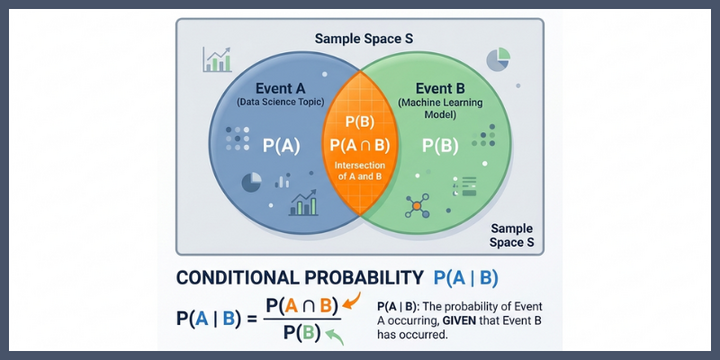
Conditional probability helps us understand how the likelihood of an event changes when we already know that another event has happened. It is a key concept in data science, statistics, and decision-making. Instead of looking at events in isolation, it allows us to adjust our expectations based on available information.
This concept is widely used in areas like medical testing, fraud detection, and recommendation systems. If you want to build a strong foundation in such practical concepts, you can consider enrolling in a Data Science Course in Mumbai at FITA Academy to gain a structured and hands-on learning experience.
What is Conditional Probability
Conditional probability is the chance of an event occurring if another event has previously occurred. It is usually written as the probability of A given B. This means we are focusing only on situations where event B is true and then checking how often A also happens.
For example, imagine you want to know the probability of picking a red card from a deck, given that the card is already known to be a heart. Since all hearts are red, the probability becomes certain. This shows how prior information changes outcomes.
The Basic Formula
The formula for conditional probability is simple and logical. It is the probability of both events happening together divided by the probability of the given condition. In easier terms, we narrow down our sample space and then calculate the likelihood.
Understanding this formula helps in solving real-world problems where information is revealed step by step. Many learners find that practicing such concepts improves their analytical thinking, and if you want to deepen your understanding, you might consider taking a Data Science Course in Kolkata to strengthen your skills further.
Step-by-Step Example
Let us break this down with a simple example. Suppose a classroom has 30 students. Out of them, 15 are girls, and 10 students like mathematics. Among those who like mathematics, 6 are girls.
Now, if we want to find the probability that a student likes mathematics given that the student is a girl, we focus only on the group of girls. Out of 15 girls, 6 like mathematics. So the conditional probability becomes 6 divided by 15.
This step-by-step filtering makes the concept clear and practical. It shows how we reduce the total possibilities based on known information.
Why Conditional Probability Matters
Conditional probability is important because most real-world decisions are based on partial information. Doctors use it to interpret test results. Businesses use it to predict customer behavior. Data scientists use it to build models that adapt to new data.
It also contributes significantly to more complex subjects, such as Bayesian reasoning and algorithms used in machine learning. Without understanding this concept, it becomes difficult to interpret model outputs correctly.
Common Mistakes to Avoid
Many beginners confuse conditional probability with regular probability. The key difference is that conditional probability always depends on a given condition. Ignoring this condition can lead to incorrect conclusions.
Another common mistake is not adjusting the sample space properly. Always remember that once a condition is applied, the total number of possible outcomes changes. Paying attention to this detail makes your calculations accurate and meaningful.
Conditional probability is a powerful tool that helps us make better decisions using available information. By understanding how probabilities change with conditions, you can analyze data more effectively and build smarter models. To master such essential concepts and apply them in real projects, join a Data Science Course in Delhi to continue your learning journey with expert guidance.
Also check: Model Interpretability and Explainable AI (XAI)